Previously, if an iPhone froze completely or the firmware crashed, you needed a Mac or at least a Windows PC with iTunes. People used to call us asking, "Is there any way to do it without a computer?" — and we honestly told them: no. iOS 27 changed that — and honestly, it was long overdue.
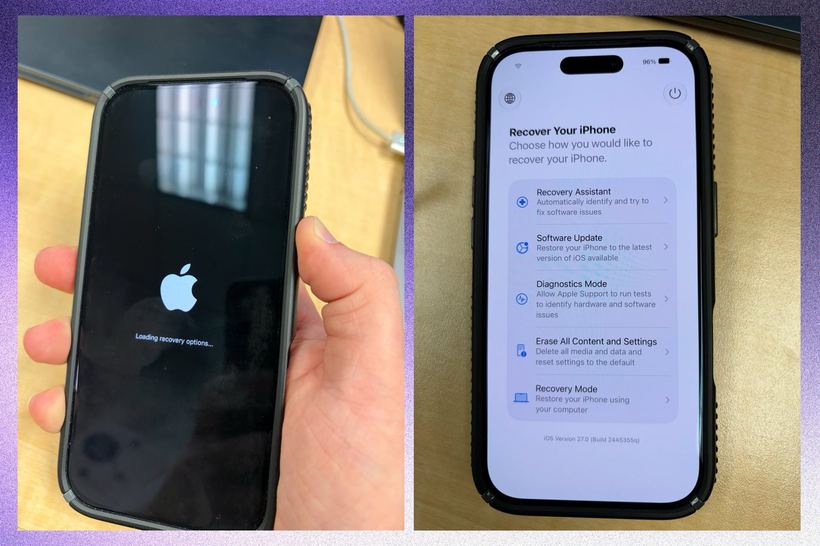
Now, a full recovery mode is built into the iPhone — just like on a Mac. To access it, turn off your phone, press and hold the power button for a few seconds. The message "Loading recovery options" will appear under the Apple logo. As soon as the menu loads, release the button.
What's inside
Five tools, each for its own situation.
Recovery Assistant is a smart feature: it analyzes the system state and suggests a specific fix option. Instead of just "reinstalling everything," it tries to repair the issue with minimal data loss. If the problem is firmware-related, it often succeeds without a full reset.
System Update — you can install iOS directly from here, even if the phone won't boot normally. This is handy when an iPhone gets stuck on the Apple logo after an update — a situation we see about three times a week.
Diagnostics Mode. Now this is really interesting: you can test the screen, battery, camera, and sensors without booting the main operating system. For someone trying to figure out what's wrong with their phone, it's a real breakthrough. Diagnostics shows data that simply wasn't publicly accessible before.
Erase All Content and Settings — a full reset without logging into iOS. If you forgot your passcode or the phone is locked, this is the way to go.
Mac Recovery Mode — a classic for severe cases when nothing else works.
A practical observation that surprised me
During the first week after iOS 27 was released, several people brought in their iPhone 16 Pro models — they had restored the firmware themselves using the new mode and came in just to make sure everything was fine. And everything really was fine. Without us.
We usually start diagnostics with a conversation: how exactly did the phone freeze, what were you doing right before that. It turns out about a third of clients who used to bring in a "dead" iPhone can now fix the issue on their own — simply by updating or doing a soft recovery without losing data. Previously, this was impossible without a computer. Countless people used to drag their phones across the entire city for nothing. 🙌
When you still can't do without a service center
The new mode is great for firmware issues. But if after recovery the phone freezes again, overheats, won't hold a charge, or goes to a black screen — it's no longer a firmware issue. It's hardware.
iPhone 14 and 15 are especially prone to power issues after corrupt updates — we see this several times a week. The power controller, battery, sometimes the logic board — that requires a soldering station, not recovery mode. 🔧
Another useful point: diagnostics in iOS 27 shows battery health in greater detail than the standard settings screen — you can see the actual charge cycle count and degradation figures. Check it out before deciding whether to replace the battery.
Is it worth updating just for this?
Yes, if you have an iPhone 12 or newer. Recovery mode is a genuinely useful feature, especially when you don't have a computer nearby. Update via standard settings when your charge is above 50% and you're on stable Wi-Fi. Don't do it right before an important trip — Apple sometimes releases patch fixes right after a major release, so it's better to wait a day or two. 📱
If you can't solve it on your own, come in for a free diagnostic at iClub.pro, Novosibirsk, 35 Kommunisticheskaya St. We'll figure it out.