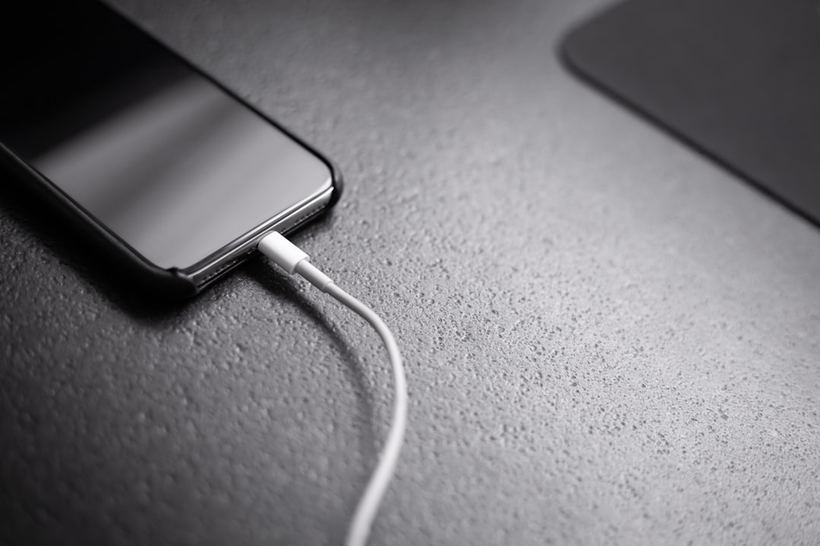
Your phone has been on the charger for an hour, but the battery level hasn't budged. Or it charges, but very slowly. Or the lightning icon appears and immediately disappears. We see these situations every day. And the first question we need to answer is: where exactly is the problem?
Three culprits that are often confused
An iPhone doesn't charge for three main reasons: a faulty cable, a dead adapter, or an issue with the charging port on the phone itself. Less often, it's a software glitch or a motherboard fault, but you should always start with the basics.
The Cable
The most frequent culprit. Lightning cables—especially cheap ones or old original ones—fray at the base of the connector. It might look fine on the outside, but the wire inside is already broken. We often see this with people who are used to charging their phone at night by draping the cable over the edge of the bed—it constantly bends in the same spot and eventually breaks right there.
The Adapter
The story with adapters is different. They either work or they don't. Overheating, a power surge—and that's it. Cheap Chinese blocks burn out quietly, without any signs. An original Apple adapter is more reliable, but it's not eternal either. It's easy to check: try a different power brick or charge it from a laptop via a USB port.
The Lightning or USB-C Port
This is where it gets trickier. Dust, pocket lint, and crumbs get into the port. Over time, a dense layer of debris builds up, and the cable simply can't reach the contacts. Sometimes it's not visible to the naked eye, but the phone won't charge or charges with difficulty. It can be worse: bent pins inside the port or oxidation—this is mechanical damage that you can't fix yourself.
What you can check yourself
- Try a different cable—preferably an original one or an MFi-certified one.
- Try a different adapter.
- Look into the port under good lighting or with a flashlight. If you see debris, carefully clean it out with a wooden toothpick. Do not use metal objects: you will scratch the contacts.
- Restart your phone. It sounds trivial, but a software glitch can sometimes block charging.
- Try charging via a computer—if it works from the computer, then the problem is in the adapter.
Two cases from our practice
Recently, someone brought in an iPhone 13—the owner said it wasn't charging at all. We checked the port and found a real ball of lint inside. We cleaned it, plugged in the cable, and it worked immediately. Not a penny for the repair, five minutes of work. That's why we offer free diagnostics—sometimes the problem is just that simple, and there's no need to turn it into a major repair.
Another case was an iPhone 14 Pro that was charging inconsistently: sometimes it worked, sometimes it didn't. It turned out that one pin inside the port was slightly bent. The owner had been using a cheap cable with a thick connector, which had gradually bent the pin. In this case, it requires a port replacement—starting from 1 500 rubles depending on the model, and we do it in a few hours.
When it's time to see a technician
If changing the cable and adapter didn't help, the port is clean, and the phone has been restarted—but it still won't charge—it's better not to try anything else yourself. Especially, do not try to straighten the pins with random objects or pour anything inside.
The cause could be a faulty power management chip on the motherboard—this is no longer a cable or port issue. Or it could be oxidation after water exposure: on an iPhone 12 and newer, water isn't always visible from the outside, but the board inside may have already suffered. If the problem appeared after a drop, it's likely the port has shifted or detached from the board, and you can't figure that out without opening it up.
If none of the above helped, come to iClub at 35 Kommunisticheskaya Street. Diagnostics are free, and we will tell you immediately what happened and how much it costs to fix. Most charging issues are resolved on the same day.