Short answer: power saving mode wins, but the difference is less than you'd expect. And what actually kills the battery fastest was discovered by accident on the third day of testing.
A week ago I took my work iPhone 16 Pro and ran an honest experiment on it. Every morning I logged the charge, then again in the evening. Recorded the conditions: what I did with the phone, which mode was enabled, how many hours it ran. First two days — standard mode with ProMotion, then — fixed 60 Hz, then — power saving mode. Load roughly the same each day: calls, messengers, a bit of YouTube at lunch. No intentional torture of the phone.
What the numbers showed
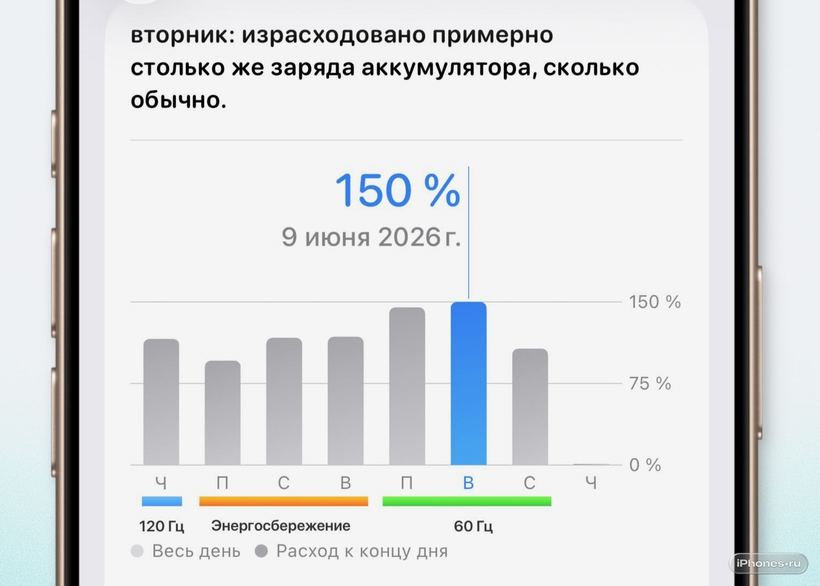
With ProMotion (120 Hz) the iPhone burned an average of 8–9% per hour during active use. Switched to fixed 60 Hz — dropped to 7–7.5%. There's a difference, but it's modest: about half an hour of extra life per day, maybe a bit more. Then I turned on the "yellow battery" and consumption dropped to 5.5–6% per hour. Now that's noticeable — the phone lives 2–3 hours longer in active mode.
But the most interesting thing came out on the third day. I forgot to turn off background refresh for three apps I don't use every day, and left location set to "always" for one old delivery service. Together they ate about as much as the entire difference between ProMotion and 60 Hz. So one random setting wiped out all the gains from changing the screen refresh rate.
Go to Settings → Battery → Battery Usage and see who was eating battery over the last 24 hours. Often there are surprises: Instagram or Mail at the top even though you didn't open them all day.
We see this picture often in our service — three times a week for sure. Someone comes in with an iPhone, says: the battery's dead, needs replacing. You check the diagnostics — capacity is 87%, perfectly alive. But in the background five apps are running with constant location access. We change the settings right there with the client — the phone starts living 25–30% longer without replacing the battery 🔋
What actually saves charge — in descending order of effect:
1. Background app refresh — turn off for everything you don't use every day
2. Location services — switch to "while using" for anything that's not navigation or maps
3. Power saving mode — noticeably helps, especially when charge drops below 30%
4. Reducing refresh rate to 60 Hz — there's an effect, but more modest than you'd expect
I'd only turn on 60 Hz mode as a last resort: when the phone really won't make it to evening and there's nowhere to charge. ProMotion isn't just a marketing term. Scrolling, animations, transitions between screens — all of this is noticeably smoother at 120 Hz, especially if you're used to it. Sacrificing comfort for 1–1.5% per hour is a questionable trade.
When settings won't help anymore
If your iPhone is losing 15–20% per hour in standby mode — this isn't a story about screen refresh rate. Most likely, either some app has gone into a loop and is spinning the processor for nothing, or the battery has physically degraded. On an iPhone 16 Pro after a year, normal capacity is 92–95% of original. If it's already below 80% — no modes will help, you need a replacement.
Checking battery health is simple: Settings → Battery → Battery Health & Charging. Message "Peak Performance Capability" — everything's fine. A warning appeared — time to see a specialist.
We do iPhone 16 Pro battery replacement in an hour, with warranty. We use original parts, price is noticeably lower than the official service — because we work directly and don't pile on middleman markups ⚡
If you can't solve it yourself — come in for free diagnostics at iClub.pro, Novosibirsk, 35 Kommunisticheskaya St. We'll figure it out.