Windows froze completely, you need the files right now, and reinstalling means losing everything you've built up. Sound familiar? At our service center, we see this at least three times a week.
Most people's first instinct is to take the computer to a repair shop or format it right away. But there's an easier way, and it fits on a 300-ruble flash drive. I've been using this method for several years myself, and it's saved me—and later our customers—more than once.
Why Linux saves the day where Windows fails
Viruses and malware for Windows are written strictly for Windows. They rely on the registry, system services, startup folders, and Win32 calls. Boot from a Linux flash drive—and the whole mechanism simply doesn't work. The virus becomes an ordinary inactive file that doesn't touch or interfere with anything.
That's why booting from a Linux flash drive is the first thing I do when someone brings in a laptop suspected of having ransomware. Not because Linux magically cures the infection—no. But from Linux, I can see the file system cleanly, without interference, and can pull out everything important before I start treating Windows.
File integrity is more important than the system itself. That's probably the main thing I've learned from five thousand repairs.
What a Linux flash drive can actually do
— Provide access to Windows files even when Windows itself won't boot
— Let you copy photos, documents, and work folders to an external drive before reinstalling
— Show disk contents without active viral processes
What it doesn't do: it doesn't cure viruses automatically, doesn't restore a damaged bootloader on its own, won't help with a physically dying drive. But it lets you work around these problems while you figure out a solution. One important caveat: if the drive is encrypted with BitLocker, the files will be visible but you won't be able to read them without the key.
How to make such a flash drive—it really takes 10 minutes
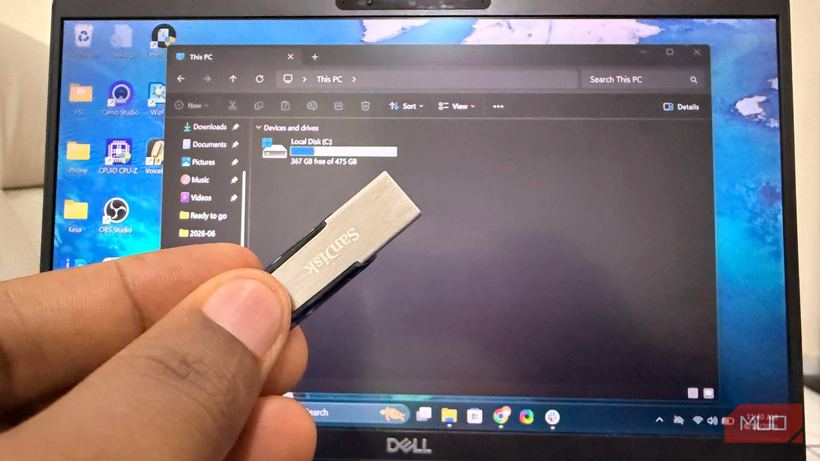
You need an 8 GB or larger flash drive, preferably USB 3.0—costs 300–500 rubles at any DNS or Citilink. Download the Linux Mint image from the official website: it's the most convenient distribution for those used to Windows, the interface is similar. Next—the Ventoy or Rufus utility, both free, with Russian interface available. Launch it, select the flash drive, copy the ISO—done.
An important point for modern laptops: check if Secure Boot is enabled in BIOS. Linux Mint is signed for Secure Boot and usually boots without issues, but it's better to make sure in advance, not in the moment of crisis. After creating the flash drive, boot from it once as a test while everything's still working. This will save you nerves later. 💾
When this really comes in handy—three scenarios from practice
The most common one for us—Windows crashed after an update. Person turns on the laptop, sees a blue screen, panic. We boot from Linux, copy everything needed to an external drive in 20 minutes, then calmly restore the system. Data is safe—that's the main thing.
Second scenario—ransomware. 🛡️ From Linux, we see what's encrypted and what's not, pull out the unaffected files, then properly clean the system.
Third—figuring out if the drive is alive at all. Sometimes they bring in a laptop saying 'it won't turn on at all,' but with a Linux flash drive it boots perfectly and the drive is readable. That means the problem isn't in the hardware but in Windows—this changes the whole repair approach.
Make such a flash drive now, while everything's working
Don't put it off until disaster strikes. A Linux flash drive is insurance that takes 10 minutes to set up. It costs less than losing important files and less than emergency repair.
If you can't do it yourself, or disaster has already struck—come in for free diagnostics at iClub.pro, Novosibirsk, ul. Kommunisticheskaya 35. We'll sort it out.