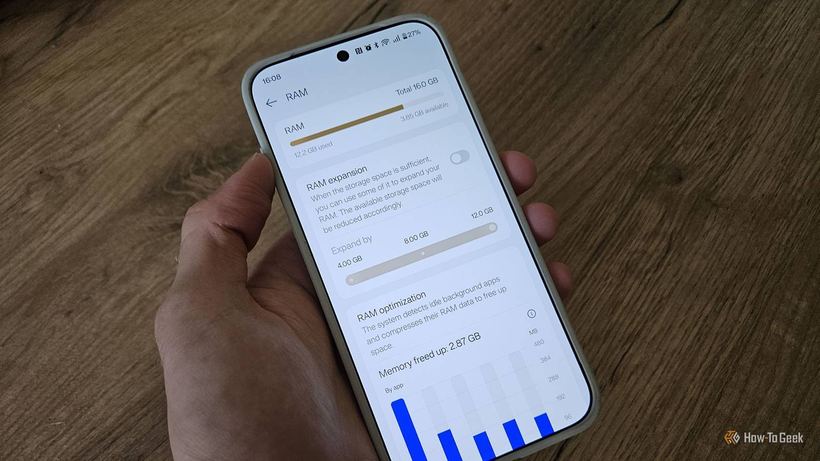
If your smartphone has become noticeably slower after a firmware update, don't jump to conclusions about wear and tear or needing a replacement. Sometimes the culprit is a single setting that the manufacturer turned on automatically. We're talking about expanded RAM.
What is expanded RAM
Depending on the brand, this setting goes by different names: "RAM Plus," "Virtual RAM," "RAM Expansion," "Memory Fusion"—the concept is the same. When your phone's RAM fills up, a portion of the slower internal storage (the kind that holds files, photos, and apps) is allocated as a temporary "buffer" for background apps.
In theory, this helps: apps don't fully close but rather "sleep" in this buffer and open faster than if they were launching from scratch. For phones with 3–4 GB of RAM, this mode can actually be useful.
Why expanded RAM can slow down your phone
In practice—especially on smartphones older than 3–4 years—the effect can be the opposite:
— Internal storage is significantly slower than RAM, and the constant data exchange between them creates extra load on the system.
— Android starts moving apps to the "slow buffer" even when regular RAM isn't full yet—switching between apps slows down.
— If internal storage is heavily filled (photos, videos, games), it already runs slower on its own, and expanded RAM puts additional strain on it.
— The processor spends resources compressing and decompressing data with each switch.
Bottom line: a phone with 6–8 GB of physical RAM often runs noticeably slower with expanded memory enabled than without it. This is especially noticeable when quickly switching between several open apps.
How to disable expanded RAM
1. Open "Settings" on your smartphone.
2. In the search bar, type "RAM" or "memory."
3. Find the "Virtual RAM," "RAM Plus," "RAM Expansion," or similar option.
4. Toggle the switch to "Off."
5. Restart your phone and use it for a few days.
If things improve—you don't need this setting. If your smartphone starts closing background apps more often—turn it back on: it means you don't have enough physical memory, and expanded RAM actually helps.
Clear storage first
Low free space is another common cause of lag. Before changing settings, do a simple "cleanup":
— Delete apps you don't use.
— Go through your gallery: delete duplicates, blurry shots, and unnecessary screenshots.
— Try to free up at least 15–20% of your storage capacity.
After that, check—your phone might speed up on its own.
If nothing helps
When your smartphone lags despite all attempts—the issue is most likely no longer in the settings. The cause could be memory wear, overheating, a firmware problem, or accumulated software junk. Come in for a free diagnostic at iClub.pro at 35 Kommunisticheskaya Street in Novosibirsk: we'll figure out what's happening with your phone and honestly tell you whether it's worth repairing or time to think about a replacement.