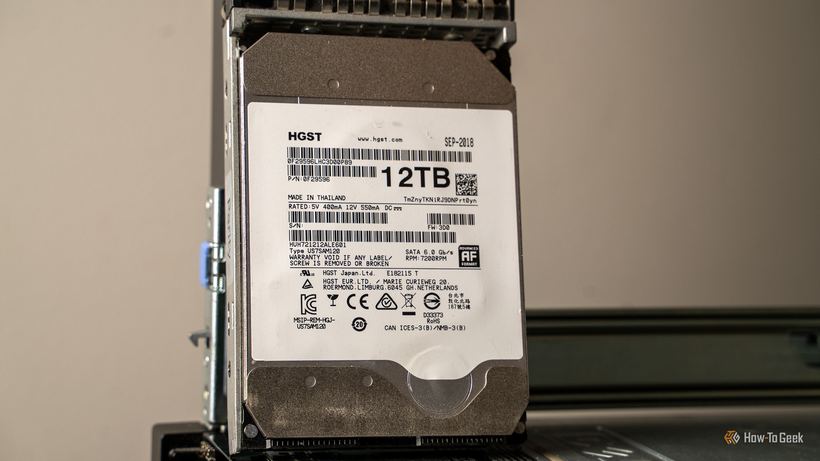
Many people buy network-attached storage (NAS), then install the first hard drive they come across—something cheap or left over from a computer upgrade. This is a mistake that can lead to data loss, premature drive failure, and denial of warranty service.
What's the Problem
A desktop drive and a NAS drive look identical, but they're designed for different conditions. A standard drive (like WD Blue) is built for moderate workload during business hours, normal ventilation inside a PC case, and periodic shutdowns. NAS works differently—24/7, non-stop, with constant read and write operations from multiple users or services simultaneously.
Why a Desktop Drive Won't Hold Up
— No workload rating. NAS drives have a clear limit—for example, WD Red Plus handles up to 180 TB per year. Desktop drives don't have such a rating because the manufacturer didn't expect this kind of load.
— SMR technology. Many budget desktop drives use shingled magnetic recording (SMR), which severely slows down RAID array rebuilding and can cause it to fail.
— Sensitivity to vibration and heat. In a NAS with multiple drives, vibration from neighboring drives builds up. Desktop drives aren't designed for such conditions.
— Warranty is voided. Manufacturers explicitly state: installing a desktop drive in a NAS is improper use. They have the right to deny warranty service.
What to Choose Instead
1. Entry level—WD Red Plus. Workload up to 180 TB/year, 3-year warranty, 24/7 operation support. Great for a home media server or backup storage.
2. Professional level—WD Red Pro. Workload up to 550 TB/year, 5-year warranty. For storage systems with many drives and high traffic.
3. For surveillance—WD Purple. Optimized for continuous recording from cameras. If the NAS is used only as a video recorder—this is the right choice.
4. Alternatives: Seagate IronWolf and Toshiba N300—similar product lines with comparable specifications.
How Not to Make a Mistake When Buying
1. Check the labeling: the name or description should include "NAS," "Red," "IronWolf," or similar.
2. Make sure the drive doesn't use SMR—look for CMR or PMR in the specifications.
3. Compare the workload rating with your needs: for home storage, 180 TB/year is enough; for business, get one with headroom.
4. Don't skimp on warranty: drives with three-year and five-year warranties are less likely to fail prematurely.
If the drive in your NAS is already making noise, disappearing from the system, or the RAID array has failed—come to iClub.pro for diagnostics. Diagnostics is free, we'll help you figure it out and find the optimal solution.