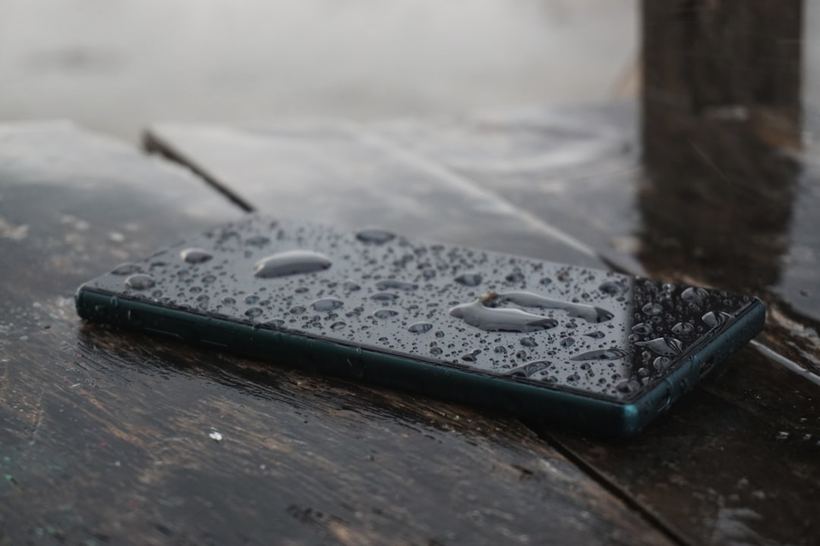
Familiar scenario: your phone dropped into the sink, got caught in a downpour, or went for a swim with you in the pool. You dried it, turned it on, and it seems to work. But something's off. The screen flickers, the sound is muffled, the touchscreen registers phantom presses, or the battery dies in two hours. That's when the real trouble starts.
An iPhone can boot up even with serious consequences of water damage. This doesn't mean everything is fine. As long as there is moisture on the board, oxidation takes its course — and what works poorly today might stop working altogether in a week.
Why your phone is acting weird
In our repair shop, we usually see three scenarios. First, partial moisture ingress through the charging port or speaker. The board is dry, but the contacts on individual components have already oxidized. This leads to unstable sound, charging issues, and a glitchy microphone. Second, the phone stayed in the water for more than a couple of minutes. In this case, moisture reaches the board, and the picture is more serious: Face ID, the camera, and the touchscreen start malfunctioning. Third, water got inside, the device dried out a bit on the outside, and the person turned it on and kept using it. This is the worst option. Residual moisture on the board under voltage accelerates oxidation manifold.
We had a case like this: an iPhone 13 was brought in three days after taking a dip in the sea. The phone turned on and even made calls, but the screen would go dark after a minute, charging only worked with one specific type of cable, and a notification about moisture in the charging port kept popping up. We opened it up — the board was covered in oxidation all along the bottom edge. Salt water is more aggressive than fresh water, and three days was more than enough for it.
What you can do yourself right now
- Turn off your phone. If it's still on, turn it off immediately. This is the most important thing. The less time the board spends under voltage with moisture, the less oxidation occurs.
- Do not put it in rice. Rice doesn't draw moisture out of electronics — that's a myth. It just sits nearby while you waste time.
- Use silica gel. Those little packets from shoeboxes. Put the phone in a bag with silica gel for 12–24 hours. It genuinely helps remove surface residual moisture.
- Do not dry it with a hair dryer. Hot air blows water around inside rather than driving it out. Plus, overheating adds more problems to the moisture.
- Wait before turning it on. At least 24 hours before pressing the power button again.
If the phone starts working normally after all this — great. But it's still best to bring it to a technician: preventive cleaning of the board from micro-oxidation can save you from a sudden breakdown a month from now.
When you need to visit the service center immediately
There are symptoms where DIY experiments will only make things worse.
- The phone won't charge or only charges in a specific cable position
- The screen flickers, with lines or dark spots appearing
- The touchscreen registers phantom presses or stops responding to touch
- The sound is crackling, gone completely, or only one speaker works
- The phone gets noticeably hot during normal use
- Face ID stopped recognizing your face
- The battery drains significantly faster than before
All of these are signs that moisture has already reached the components. This requires ultrasonic board cleaning and diagnostics of each module individually. This is not something that can be fixed with a hair dryer or a bag of silica gel.
Recently, someone brought in an iPhone 14 Pro — the owner dropped it in the bathtub, but the phone worked normally for two whole weeks. Then suddenly it stopped turning on altogether. A classic story: oxidation brewed gradually until it reached a critical contact. If she had come in earlier, board cleaning would have cost 2–3 thousand rubles. In the end, a much more serious repair was required.
Come on in — we'll sort it out
If your iPhone is acting strange after water exposure and you don't know what's going on, come to iClub at 35 Kommunisticheskaya Street. Diagnostics are free. We'll take a look inside and tell you honestly: can it be fixed, how much it costs, and whether it's even worth it. No beating around the bush.